wide plank flooring
Wide-Plank Flooring: How Wide Can You Go in an Arizona Home?
Honest & Affordable Floor Covering · Arizona 5 min read
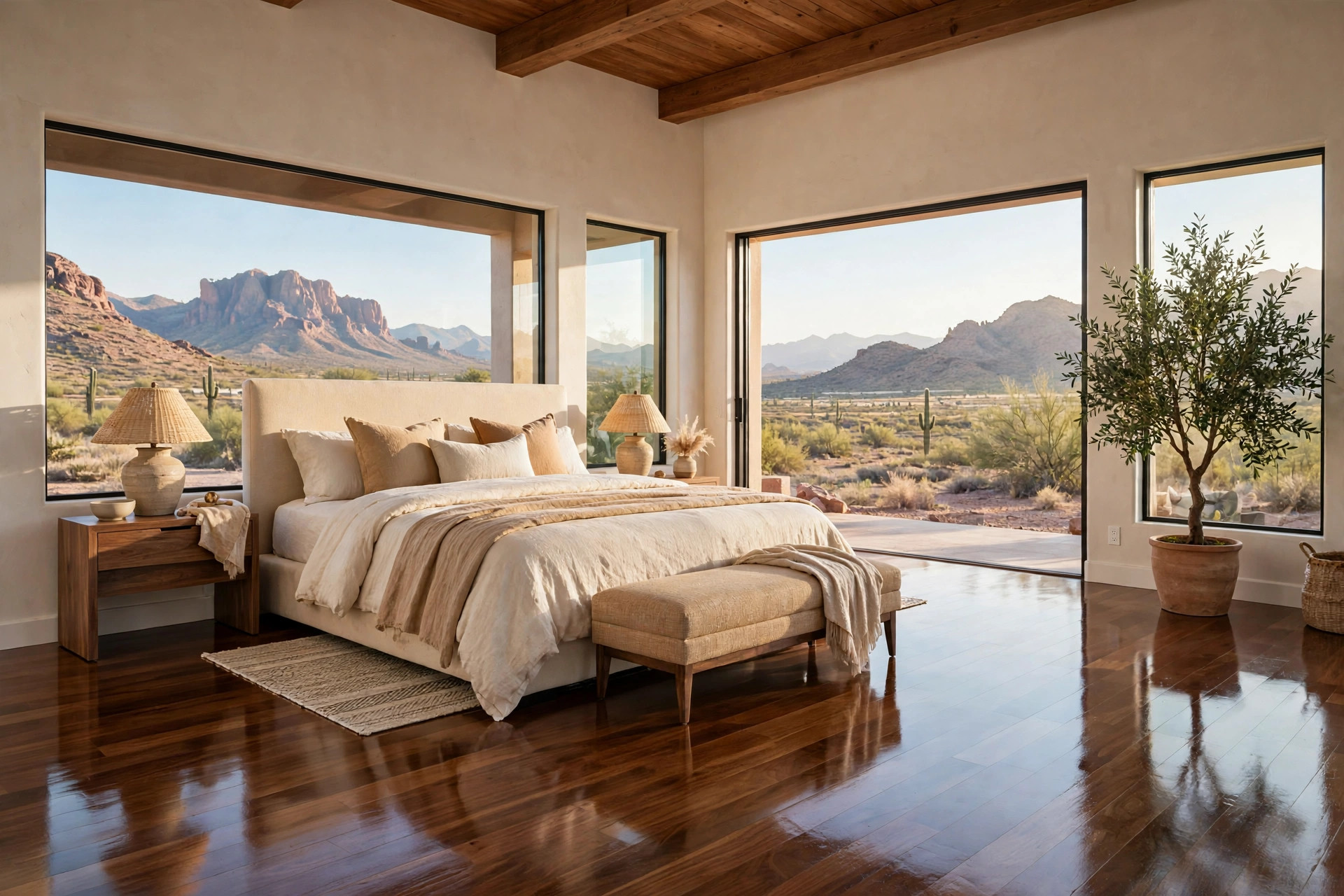
Wide-plank flooring is a format decision, not a species one: 5 to 7 inches reads modern and safe, 9 inches and up makes a statement the slab and the sun get a vote on. Engineered, hardwood, and LVP, room by room — and the small-room honesty nobody adds.
How wide can you go with wide-plank flooring in Arizona?
As wide as your construction choice allows — and in Arizona, construction matters more than width. The practical bands are these: planks in the 5 to 7 inch range are the modern mainstream, wide enough to read contemporary and calm, forgiving enough to behave on a concrete slab. At 9 inches and up, every plank becomes a statement and a responsibility: the wider a real-wood board is, the more any seasonal movement shows in a single joint, and the more the slab's flatness and the room's sun exposure get a vote.
This guide is about format — width — across hardwood, engineered hardwood, and LVP. It is deliberately not the species conversation: if you are deciding between oaks and colors, our White Oak Floors guide covers species and tone. Width is the decision underneath that one: the same white oak reads completely differently at 5 inches than at 9, and it behaves differently too.
5 to 7 inches: the width that works almost everywhere
The 5 to 7 inch band is where most East Valley wide-plank jobs honestly land, for good reasons. The look is modern without being extreme — fewer seams than a narrow board, long calm lines across an open floor plan — and in engineered hardwood, which is the wood Arizona installers actually put on slabs, this width is well within what a layered, cross-grained core can hold stable in dry desert air.
LVP lives comfortably here too, and it is where wide-plank vinyl makes the most sense: a rigid SPC core at this width handles sunny rooms and heavy traffic without the movement drama that heat can bring. In this band, width is mostly a style choice. Above it, width becomes an engineering choice as well, and it should be made with open eyes.
9 inches and up: the statement widths, honestly priced in risk
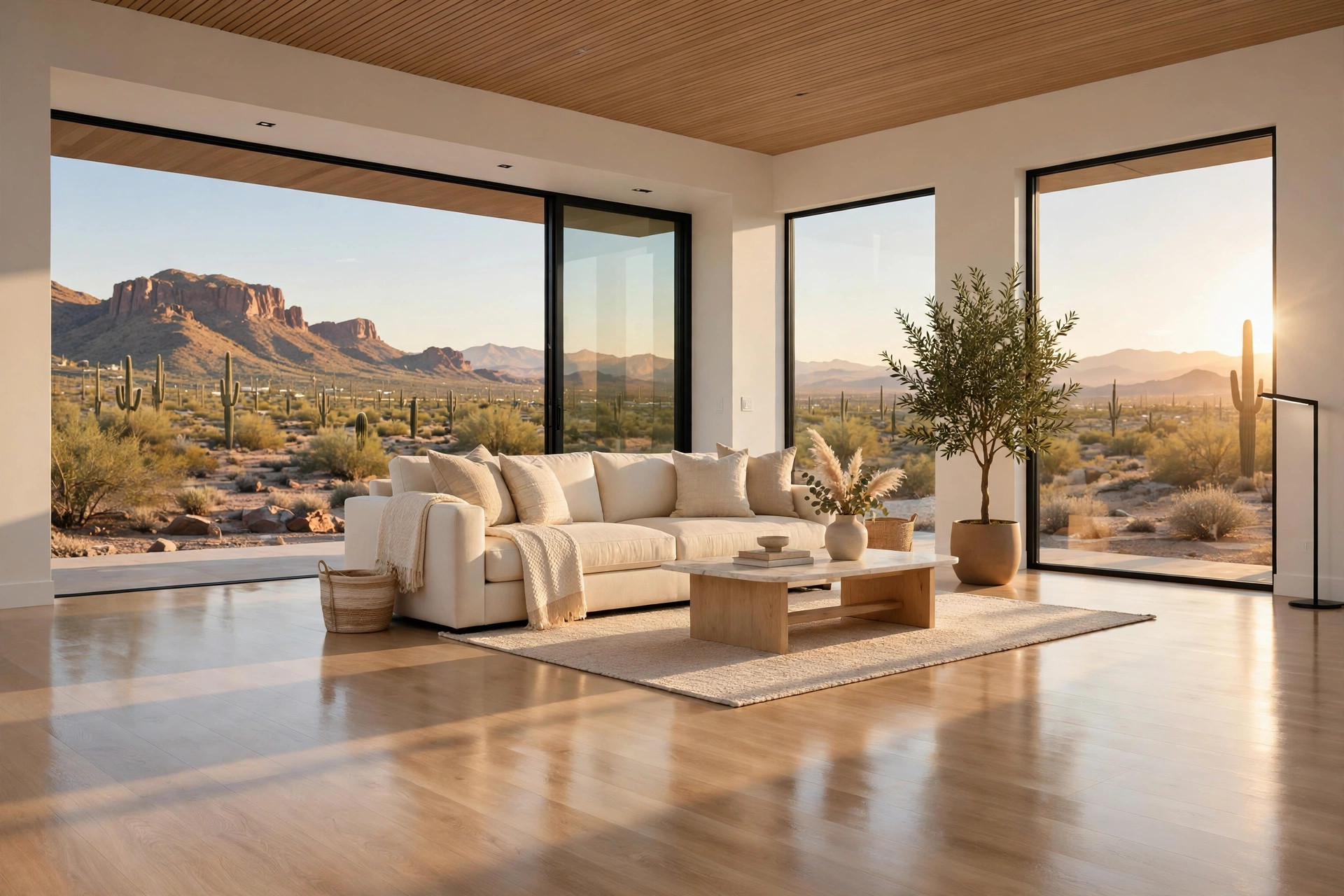
At 9 inches and wider, three Arizona realities converge. First, movement: hardwood shrinks and gaps across its width as it loses moisture, and a very wide solid plank can shrink enough over a dry Phoenix winter to open a visible gap at a single joint — the same seasonal movement a narrower floor spreads invisibly across many joints. Engineered construction moves a fraction as much because its layers cancel each other, which is why the widest real-wood planks in Arizona should be engineered, on a moisture-tested slab, every time.
Second, flatness: a wide plank bridges slab imperfections instead of following them, so the published spec — flat within 3/16 of an inch over 10 feet — stops being a formality. Third, sun: a wide, dark field in front of west-facing glass takes the full heat load this site warns about for vinyl and wood alike, and fading or expansion shows across one broad face rather than being broken up by seams. None of this forbids 9-inch-plus floors. It means they belong in engineered or quality rigid-core form, in rooms whose sun you have thought about, over a slab that was actually prepped.
Small rooms: the honesty the brochures skip
Wide planks in a small room are neither the automatic mistake nor the automatic space-maker they are sold as. Fewer seams can make a small room feel calmer and less busy — a powder room or small bedroom in a 5 to 7 inch plank often reads larger for exactly that reason. But push the width toward the room's scale and the math turns: in a genuinely small room, 9-inch-plus planks can leave you with very few full boards, a layout dominated by cuts, and proportions that feel like a big floor shrunk rather than a room made grand.
The honest test is the dry layout and the sample board in the actual room, in its actual light. Width is relative to the space it lands in: the same plank that looks serene across an open great room can look restless in a narrow hall, where long narrow runs are what the eye wants. Let the room vote before the order is placed — installers would rather move a sample ten times than a floor once.
What wide plank costs — inside the published frames
Width does not come with its own honest price tag, and be wary of any per-width chart that pretends otherwise: a wide-plank floor is priced as the material it is. In the published Phoenix frames on this site, LVP typically runs $4.50 to $9 per square foot installed, engineered hardwood $7 to $13, and solid hardwood $9 to $16 — with removal of the old floor typically adding $1 to $2.50 per square foot and slab prep $1 to $3 where the slab needs it. Species, spec, and slab condition move your number inside those frames far more than width alone does.
So decide width on look and behavior — construction first, sun and slab second, room scale third — and let the estimate price the floor you actually chose. That ordering is the whole guide in one sentence.
Get a free, exact estimate
Choosing a width? Read our White Oak Floors guide if species and color are still open — it is the companion piece to this format guide — then compare our Hardwood Flooring and LVP Flooring service pages for the wide-plank options in each material, and run the flooring cost calculator with your square footage to see your rooms inside the published installed ranges. For the exact number, Honest & Affordable Floor Covering starts with a free consultation and an honest, upfront quote — samples in your light, slab tested, no hidden fees. Call (602) 854-8363. Based in the East Valley — Gilbert, Mesa, Chandler, Ahwatukee, and Paradise Valley — and serving homeowners across Arizona.
Homeowners across Arizona rate Honest & Affordable five stars on Google for honest pricing, on-time crews and floors built to last. 20+ years of experience, fully licensed & insured.
Frequently asked questions
What is considered wide-plank flooring?+
Planks in the 5 to 7 inch range are the modern wide-plank mainstream, and 9 inches and up are the statement widths. Below that band you are in traditional narrow-board territory. The right width depends on construction, room scale, and sun — not on the label alone.
Can you go 9 inches wide with hardwood in Arizona?+
In engineered form, yes — engineered construction barely moves in dry desert air and glues directly to a prepared, moisture-tested slab. A solid plank that wide is the risky version: solid wood shrinks across its width in Phoenix's dry air, and a very wide board concentrates that movement into visible gaps at single joints.
Do wide planks make a small room look bigger?+
Sometimes — fewer seams can make a small room feel calmer, especially at 5 to 7 inches. At 9 inches and up in a genuinely small room, you can end up with few full boards and a layout dominated by cuts, which reads as a big floor shrunk. Judge samples in the actual room before ordering.
Ready for new floors?
Free consultation, honest upfront quote — no hidden fees. Serving all of Arizona from the East Valley.